Press releases
President Vahagn Khachaturyan met with Prime Minister Nikol Pashinyan
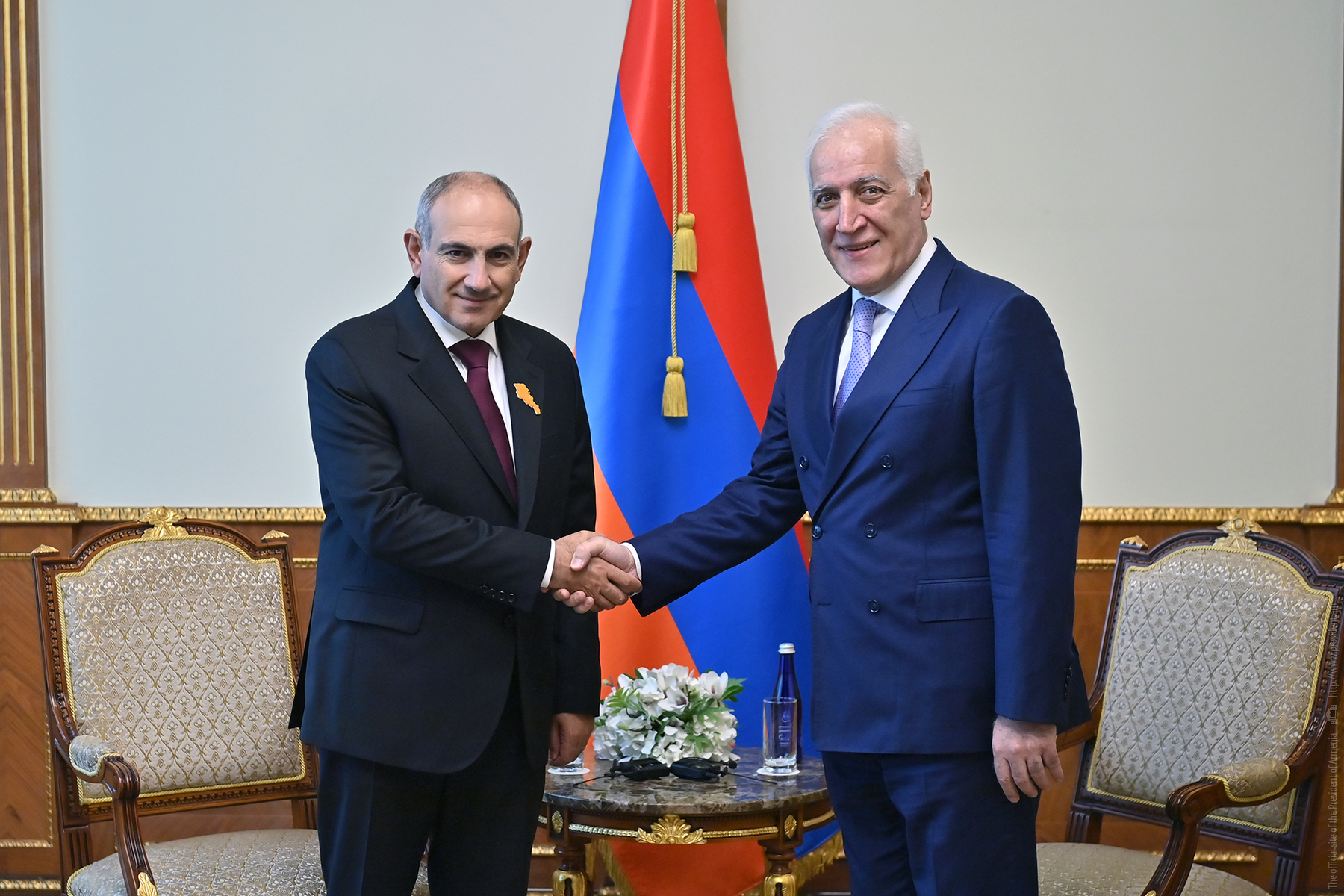
President of the Republic Vahagn Khachaturyan met with Prime Minister Nikol Pashinyan at the Presidential Residence.
President Vahagn Khachaturyan:
“Mr. Prime Minister, I am glad to have this meeting. We have had opportunities to speak about the elections, of course, we have discussed them many times, but it is very important to speak officially and publicly in this format as well, so that we can also present our assessments.
First of all, I would like to congratulate all of us on the occasion of the holding of regular democratic nationwide elections in the Republic of Armenia, because after what happened in 2021, everyone thought, excuse me for putting it this way, that, in any case, there would be another early election rather than a regular one. But life has shown that when the authorities have clear approaches, a programme and objectives, and implement them, political and state institutions function, and we have reached the stage of regular elections, which is very important.
In this regard, the 2026 elections mark a new milestone in the political development of the Republic of Armenia. This should also be duly assessed. In this regard, it was also very important that our citizens responded to the call and actively participated.
Taking this opportunity, I would also like to express my gratitude to all citizens of the Republic of Armenia who actively participated in the elections and cast their votes for the political force that currently constitutes the majority in Parliament. In this regard, I would like to congratulate You personally and the Civil Contract party on receiving the trust of our citizens and, with the mandate of the majority of votes, forming the National Assembly, which will also lead us over the next five years.
But I would like to draw attention to one important circumstance, because for a long time I studied relations between society and government purely at an academic level and wanted to understand how this takes place and how it is implemented. In this case, these elections were the result of that process: on the one hand, they represented an assessment of the work carried out over the past five years, and on the other hand, an assessment of the expectations that the Civil Contract party had presented to the people during the pre-election campaign.
And now the Civil Contract party has received votes from citizens, on the basis of which the Government and the newly formed authorities will act, leading us towards a future where we, that is, the voters, are confident that we will have a safer environment in Armenia, that we will truly become a prosperous country, and that all the programmes that have been presented will become a reality.
Finally, I would like to particularly emphasise that we are indeed holding elections in conditions of peace. Peace has been established in Armenia. We—the authorities, by which I mean the Government in this case, and You, through the balanced foreign policy have been able and have pursued to reach a situation where we essentially no longer have contentious issues with our neighbours that could create situations of war. On the contrary, a situation has now been created in which we genuinely have an opportunity to finally establish diplomatic relations with our neighbours, establish good-neighbourly relations and be of benefit to one another.”
Prime Minister Nikol Pashinyan:
“Thank you, Mr. President, for Your congratulations. I am glad to have this opportunity to meet.
Yes, regular parliamentary elections were held, and Civil Contract has a majority of seats in Parliament, and we will form the Government. Of course, the elections were quite intense, and for us, and for me personally, this was also a very important platform for intensifying direct communication with the people and citizens. During this period, we also received a great deal of information about the processes taking place, as well as citizens’ assessments, impressions and opinions.
Of course, it is unequivocal that citizens support the peace agenda, and the peace that has been established has played a significant role in citizens’ voting decisions. In my impression, the school construction programmes, kindergarten construction programmes, the large-scale capital investments carried out by the Government, and, of course, the social reforms also played a role. But, of course, as a result of the elections, we also faced a number of problems regarding which there is concern and criticism among citizens towards the Government, the state and me personally.
These problems primarily concern the areas of justice and fairness. However uncomfortable it may be for me to say this, I understand that the following question naturally arises: why have these problems not been resolved in eight years? I do, of course, have explanations and have provided clarifications, including due to the constitutional immunities that we have in some judicial sectors.
But, in general, these elections revealed new challenges. The widespread distribution of electoral bribes exposed the vulnerabilities of our state, which we will inevitably have to consider. And our response to both the positive and negative phenomena that emerged during the elections is the following: we must continue and intensify the reform process and, on the contrary, use this opportunity to restart our entire reform agenda, beginning with the fight against corruption and continuing with institutional and economic reforms.
Of course, for this, we have received sufficient energy and a mandate from the citizens of the Republic of Armenia. And it is clear to me that we need to review our reform agenda once again, identify what has not been sufficiently effective and where our strategic objectives have not been achieved, and try to make additional decisions and introduce additional factors to address those issues.
One thing is clear: democracy in the Republic of Armenia is irreversible. By democracy, we first and foremost mean that power belongs to the people. Of course, it is concerning that attempts have been made to take power away from the people, but it is also important that, nevertheless, those manifestations were unable to achieve the results they sought.
On the contrary, they have revealed the field to us, and we can act in a more targeted and effective manner so that such phenomena are excluded in future elections. Of course, the further improvement of the electoral system is also an issue, as is ensuring transparency in the financing of political parties, media outlets, organisations, and so on.
But, of course, our main pre-election message is to ensure average annual economic growth of 6%, and we must work towards this goal. And, frankly speaking, I consider this realistic, also seeing and feeling the determination of the citizens of the Republic of Armenia to work and create prosperity through their work for their own families and, consequently, for the country and the state, which is, of course, very important.
I should say that following the elections, we are observing an increase in economic activity, which also means that the election results have brought a certain degree of enthusiasm.
Although, as you know, certain problems related to the Eurasian Economic Union arose during the elections, nevertheless, wherever problems arise, those problems can also bring new opportunities, including the opportunity to transform a balanced foreign policy and a policy of balancing into a balanced and diversified economic policy. We are already seeing signs of this.
This does not mean that there will be no difficulties. I believe that difficulties always exist and arise every day. The issue is how capable we are of managing those difficulties. I am confident that we will manage them successfully, including with your support.
I would also like to thank you for Your support for the activities of the Government during the previous period. In the near future, of course, we will have an opportunity to discuss the newly formed Government. We will also have to adopt the programme of the newly formed Government and, of course, implement it.
Thank you.”